·Risk Management·Position Sizing·Trading Psychology
Fixed Risk vs. Fixed Contracts: Why Most Traders Get Position Sizing Wrong
Trading the same number of contracts regardless of stop distance creates wildly inconsistent risk. Learn why fixed-risk position sizing is the professional approach.

There are two fundamental approaches to position sizing in futures trading. One is used by amateurs. The other is used by professionals. The difference between them explains a significant portion of why most traders fail to achieve consistent results.
The Two Approaches
Fixed Contracts (The Amateur Method)
"I always trade 2 ES contracts."
This is the most common approach among retail traders. It's simple, requires no calculation, and feels consistent. But it creates a dangerous illusion of consistency — because while your contract count stays the same, your actual dollar risk changes on every trade.
With 2 ES contracts:
- A 4-tick stop = $100 at risk
- A 10-tick stop = $250 at risk
- A 20-tick stop = $500 at risk
Same position size. Completely different risk profiles. Your tight-stop scalp risks $100, but your swing trade risks 5x more. If the swing trade loses, it wipes out multiple winning scalps.
Fixed Risk (The Professional Method)
"I always risk $200 per trade."
With this approach, your dollar risk is identical on every trade. The number of contracts adjusts based on stop distance:
With $200 fixed risk on ES:
- A 4-tick stop = 4 contracts ($200 risk)
- A 10-tick stop = 1 contract + MES ($200 risk)
- A 20-tick stop = MES contracts ($200 risk)
Same risk. Different position sizes. Every trade has exactly the same impact on your account.
Why Fixed Risk Wins: The Math
Let's run a simulation. Both traders take the same 10 trades with the same entries, exits, and stops. The only difference is position sizing.
Setup: 10 trades on ES futures. Win rate: 50%. Average winner: 12 ticks. Stops vary between 5 and 20 ticks.
Trader A (Fixed 2 contracts):
- Wins range from +$150 to +$600
- Losses range from -$125 to -$500
- Net result: highly dependent on which trades had wide stops
Trader B (Fixed $250 risk):
- Every win is proportional to the R:R ratio
- Every loss is exactly -$250
- Net result: predictable and directly tied to strategy edge
Trader B's equity curve is smoother. Drawdowns are more predictable. Risk of ruin is calculable and manageable.
The Hidden Danger of Fixed Contracts
The real problem with fixed contracts isn't just inconsistency — it's that your worst losses come from your widest stops, which are often your lowest-conviction trades.
Think about it:
- A-setup with tight stop (8 ticks): 2 contracts = $200 risk
- B-setup with wide stop (20 ticks): 2 contracts = $500 risk
You're risking more money on your worse setups. This is the exact opposite of what any risk management framework recommends.
With fixed risk, this inverts naturally:
- A-setup (8 ticks): 2 contracts = $200 risk
- B-setup (20 ticks): MES contracts = $200 risk
Now your risk is constant regardless of setup quality. If you want to risk less on B-setups, you can use risk presets — reducing to 50% or 25% of your standard risk with a single click.
The Objection: "But I Lose More Contracts on Tight Stops"
Yes, with fixed risk, tighter stops mean more contracts. This feels counterintuitive. But consider: if your stop is tighter, the market needs to move less against you to stop you out. You're risking the same dollars either way.
The discomfort comes from seeing a larger position size. But the actual risk — the dollars at stake — is identical. And that's what matters to your account.
Risk Presets: The Next Level
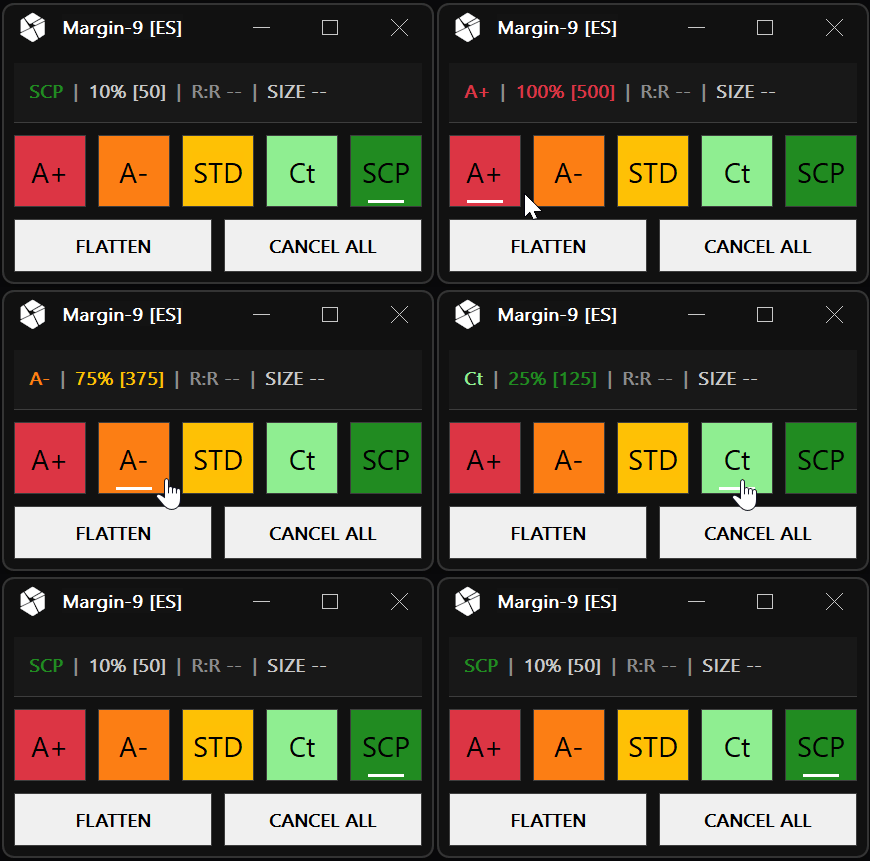
Professional position sizing goes beyond just "fixed risk." The best traders adjust their risk level based on setup quality:
| Setup Quality | Risk Level | Example ($500 base) |
|---|---|---|
| A+ (High conviction) | 100% | $500 risk |
| A- (Good setup) | 75% | $375 risk |
| Standard | 50% | $250 risk |
| Counter-trend | 25% | $125 risk |
| Scalp/test | 10% | $50 risk |
This is exactly how Margin-9 works — five configurable risk presets that let you switch between risk levels instantly, while maintaining fixed-risk position sizing at every level.
How to Implement Fixed Risk Today
-
Decide your base risk amount. Start with 1-2% of your account, or a fixed dollar amount you're comfortable losing on any single trade.
-
Memorize your tick values. ES = $12.50, NQ = $5.00, CL = $10.00, MES = $1.25, MNQ = $0.50.
-
Calculate before every trade: Contracts = Risk / (Stop Ticks × Tick Value).
-
Use micro contracts when the math doesn't produce whole numbers with full-size contracts.
-
Consider automation. Manual calculation under pressure leads to shortcuts and errors. This is why automated position sizing tools exist — they eliminate the human element from what should be a purely mathematical decision.
The Bottom Line
Fixed contracts feel consistent but create inconsistent risk. Fixed risk feels inconsistent (because your position size changes) but creates mathematically consistent exposure.
Every professional risk management framework — from hedge funds to prop firms — uses some form of fixed-risk sizing. The only reason retail traders don't is because it requires more effort per trade.
Automate the effort, and the excuse disappears.
Noesis Analytics
Put the numbers on your chart.
Level statistics and automatic position sizing for Sierra Chart — with a 7-day free trial.