SLS.*v1.2.3
Powerful Probability-Driven Analytics Suite
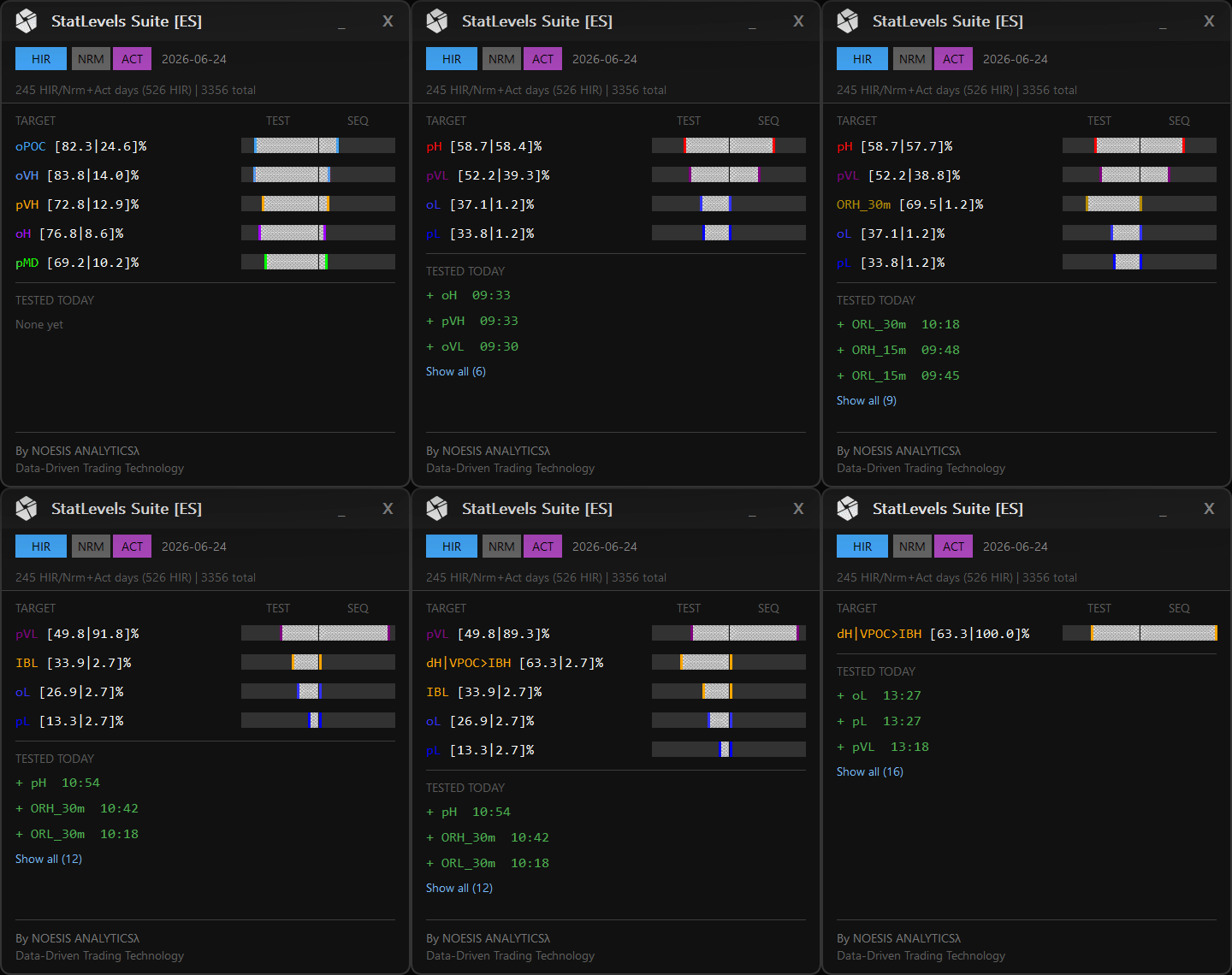
27 price levels — each with historical test rates conditioned on Open Type, IB Range Regime, and ETH Range Regime. A Markov-based sequence panel predicts the next target. Line thickness encodes probability at a glance.
On a mobile device? Send this page to your workstation.
From guessing
to knowing.
See the difference between hoping a level works and knowing its historical probability.
Static lines, no hierarchy
15+ levels on chart. Which ones actually matter today?
Probability-weighted zones
High probability — primary target
Low probability — de-prioritize
Moderate-high — secondary target
Context: HIR Day
[Context-Aware]
Statistics change with market context
Every RTH open is classified based on position relative to the prior day's range and close. Statistics are segmented by Open Type — the first of three conditioning dimensions.
Higher Out of Range
Opens above prior day high
Higher In Range
Opens above close, below high
Neutral Open Range
Opens equal to close
Lower In Range
Opens below close, above low
Lower Out of Range
Opens below prior day low
Why context matters
On HOR days, prior day low test rates often exceed 70% (pullback expected). On LIR days, the same level might show only 35%. Same level, different context, different probability.
[Regime-Conditioned]
Same Open Type. Different regime. Different odds.
Open Type alone is not enough. A HOR day with a narrow IB after a quiet overnight behaves fundamentally different from a HOR day with a wide IB after an active overnight. SLS. conditions statistics on both dimensions automatically.
IB Range Regime
Initial Balance vs. Prior Day Range
IB range small relative to prior day — range expansion likely
IB range proportional to prior day — balanced conditions
IB range already covers much of prior day — mean reversion likely
ETH Range Regime
Overnight Range vs. Prior Day Range
ETH range < 50% of prior day — limited price discovery overnight
ETH range ≥ 50% of prior day — significant overnight movement
Combined key: Open Type + IB Regime + ETH Regime creates composite buckets like HOR_NQ, LIR_WA — each with its own test rates. Automatic fallback to unconditional stats when sample size is below 15 days.
Why regime conditioning matters
Unconditional test rates average across all market conditions — they're the right number for no specific scenario. Regime conditioning surfaces the actual edge: Narrow IB + Quiet ETH days show significantly higher range-expansion rates (pH/pL tests), while Wide IB + Active ETH days favor mean-reversion (IBH/IBL holds).
[Visual Encoding]
Instant recognition without reading
Line thickness and style communicate probability at a glance. Scan your chart in seconds to identify high-priority levels.
Thick solid line
High-probability target
Normal solid line
Secondary reference
Dotted line
De-prioritize today
[Dynamic Updates]
Statistics that adapt as you trade
When a level is tested, probabilities update in real-time. Paired levels receive conditional AND-statistics.
Session opens
pH shows 67%, pL shows 45%
Price tests pL
pL stat drops to 0% (tested)
pH receives AND-stat
pH updates to 14.2% (conditional)
The AND-statistic represents: "Given pL was tested, what's the probability pH also tests?"
OR Statistics
"pH or pL" shows probability of testing either extreme. Useful for assessing overall range extension likelihood.
AND Statistics
"pH & pL" shows probability of testing both extremes. High AND-stat suggests trend day or double distribution.
[Predictive Panel]
Sequence prediction — what gets tested next?
A Markov transition matrix built from historical level-test sequences predicts the most likely next target. Conditioned on Open Type, IB Regime, and ETH Regime.
Sequence collected
Each historical day records the order in which levels were tested (e.g., oH → pH → IBL → pL)
Transition matrix built
From all observed sequences: given the last tested level, what was tested next? Grouped by regime composite key.
Panel ranks targets
After each live test event, probabilities update. Targets ranked by Bayesian-smoothed transition probability.
Fallback hierarchy: regime-conditioned bucket → Open Type bucket → aggregate over all types. Sample-size-aware weighting prevents thin buckets from dominating the prediction.
Markov Transitions
Historical sequences encoded as state transitions. Each level-test event updates the current state and recalculates next-target probabilities from the matching regime bucket.
Bayesian Ranking
Multiple ranking formulas available (incl. Bayesian Logit Blend, Robust Shrunk Ensemble). Confidence scores adapt to sample size — thin data shrinks toward the prior instead of showing noisy estimates.
VPOC Migration Targets
When the session VPOC migrates above IBH or below IBL, dynamic dH/dL levels appear. These represent directional conviction from volume migration — tracked with full test statistics.
OR Window Statistics
Five Opening Range periods (0.5m, 1m, 5m, 15m, 30m) — each with independent High/Low test rates. Automatically disabled when chart timeframe exceeds the OR period.
[Your Trading Day]
From preparation to edge accumulation
Pre-Market
Before market open
- All key levels plotted — previous session and overnight activity
- Review level placement and plan entry scenarios
- Stats go live on first bar — full context from open
Market Open
RTH session start
- Open Type auto-classified (HOR/HIR/NOR/LIR/LOR)
- IB + ETH regime detected — statistics conditioned on context
- Scan for thick lines (priority levels)
During Session
Live trading
- Tested levels drop to 0%, partner levels receive AND-stats
- Sequence panel predicts next target from transition matrix
- VPOC migration creates dynamic dH/dL targets
Post Session
After close
- Today's data added to database
- Statistics improve over time
- Your edge compounds daily
[27 Levels Tracked]
Complete coverage of key references
Prior day, overnight, initial balance, five opening range windows, and dynamic VPOC migration targets — each with historical test rate statistics conditioned on Open Type and market regime.
Prior Day
7High, Low, POC, Midpoint, Close, VAH, VAL
Overnight
6Globex session price and volume profile
Initial Balance
2First 60 minutes of RTH
Opening Range
10Five OR windows — High + Low for each
VPOC Migration
2Probability of a new day High/Low when the session VPOC migrates above IBH (dH) or below IBL (dL)
[Built For]
Traders who think in probabilities
StatLevels Suite (SLS.) is designed for intermediate to advanced futures traders who understand that edge comes from objective data, not intuition.
SLS. builds its own statistics directly from the chart's historical data where it is loaded. You also receive a free starter dataset with more than three years of statistics.
Not for: Signal seekers expecting buy/sell alerts. SLS. provides statistical context — it doesn't replace your trading decisions.
Optimized for futures with defined RTH and overnight sessions
[Pricing]
Start with a free trial→
Full functionality for 3 days. No credit card required. Choose a plan when you're ready.
Coming Soon
We're currently updating our payment system. Pricing and checkout will be available shortly.
30 Days
Perfect for testing your edge
- Full access
- 30 days
- Email support
Monthly
Flexible access with cancel anytime
- Full access
- Monthly billing
- Cancel anytime
Yearly
Best value for long-term traders
- Full access
- Yearly billing
- Priority support
Lifetime
Own it forever with free updates
- Lifetime access
- Free updates
- Priority support
[The Statistical Edge]
Replace intuition with historical probability.
Every level on your chart becomes a data point, and your edge compounds over time — objectively, automatically.
Pair with Margin-9 for automatic position sizing and complete risk management.