·Risk Management·Position Sizing·Futures Trading
How to Calculate Position Size in Futures Trading
Learn the exact formula to calculate your futures position size based on risk per trade, stop distance, and tick value. Step-by-step examples for ES, NQ, and CL.
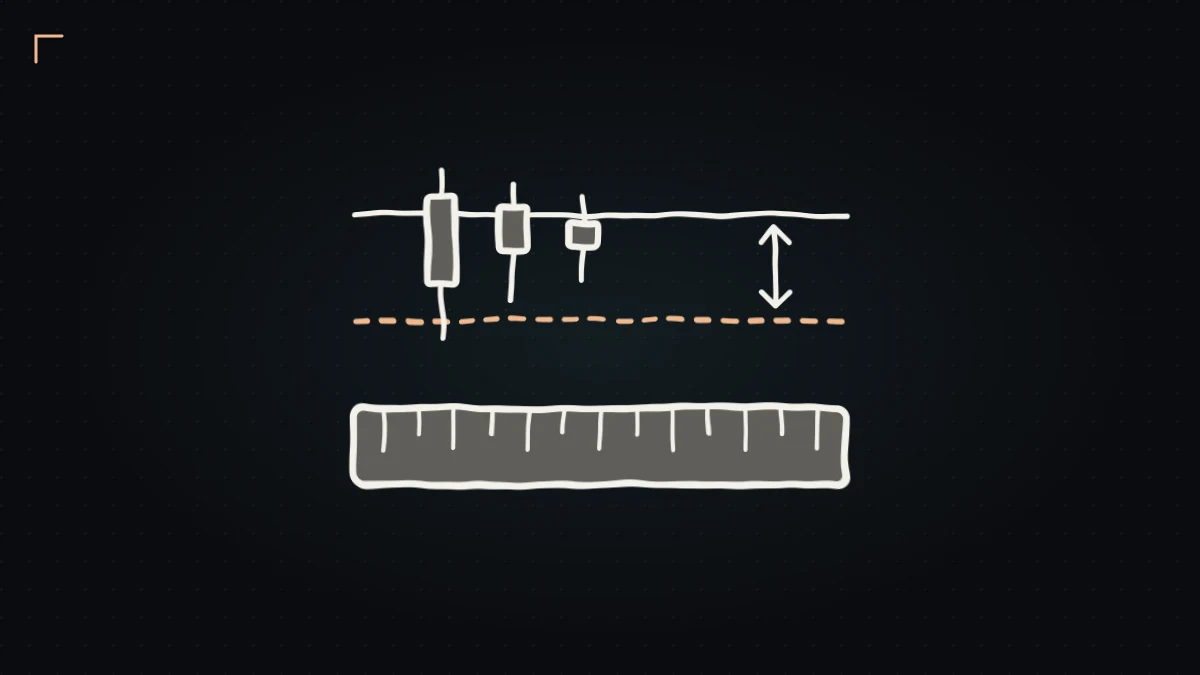
Position sizing is the single most important risk management decision you make on every trade. Get it wrong, and even a winning strategy will blow your account. Get it right, and you create a mathematically consistent framework that lets your edge compound over time.
Yet most futures traders either skip this step entirely or calculate it inconsistently. This guide walks you through the exact formula, with real examples for the most popular futures contracts.
The Position Size Formula for Futures
The formula is straightforward:
Contracts = Risk Amount / (Stop Distance in Ticks × Tick Value)
That's it. Three inputs, one output. Let's break each one down.
Step 1: Define Your Risk Per Trade
Your risk amount is the maximum dollar amount you're willing to lose if your stop-loss gets hit. This should be a fixed dollar amount or a fixed percentage of your account.
Common approaches:
- Fixed dollar amount: $200 per trade, regardless of account size
- Percentage-based: 1-2% of account equity per trade (e.g., $200 on a $20,000 account)
The key principle: your risk should be the same on every trade. Whether your stop is tight or wide, the dollar amount at risk stays constant. The position size adjusts instead.
Step 2: Measure Your Stop Distance
Count the number of ticks between your entry price and your stop-loss price.
For example, on ES (E-mini S&P 500):
- Entry at 5,000.00
- Stop at 4,997.50
- Distance = 2.50 points = 10 ticks (since ES tick size is 0.25)
Step 3: Know Your Tick Value
Every futures contract has a fixed dollar value per tick:
| Contract | Tick Size | Tick Value |
|---|---|---|
| ES (E-mini S&P 500) | 0.25 | $12.50 |
| MES (Micro E-mini S&P) | 0.25 | $1.25 |
| NQ (E-mini Nasdaq) | 0.25 | $5.00 |
| MNQ (Micro Nasdaq) | 0.25 | $0.50 |
| CL (Crude Oil) | 0.01 | $10.00 |
| YM (E-mini Dow) | 1.00 | $5.00 |
Step 4: Calculate
Now plug the numbers in.
Example 1: ES Futures
- Risk: $500
- Stop: 10 ticks (2.50 points)
- Tick value: $12.50
- Contracts = $500 / (10 × $12.50) = $500 / $125 = 4 contracts
Example 2: NQ Futures
- Risk: $300
- Stop: 20 ticks (5.00 points)
- Tick value: $5.00
- Contracts = $300 / (20 × $5.00) = $300 / $100 = 3 contracts
Example 3: CL Futures (Crude Oil)
- Risk: $200
- Stop: 10 ticks ($0.10)
- Tick value: $10.00
- Contracts = $200 / (10 × $10.00) = $200 / $100 = 2 contracts
Example 4: MES Micro Futures (Small Account)
- Risk: $100
- Stop: 10 ticks (2.50 points)
- Tick value: $1.25
- Contracts = $100 / (10 × $1.25) = $100 / $12.50 = 8 micro contracts
Why This Matters More Than Your Entry Strategy
Consider two traders with the same strategy:
Trader A uses 2 contracts on every trade, regardless of stop distance:
- Trade 1: 5-tick stop = $125 risk
- Trade 2: 20-tick stop = $500 risk
- Trade 3: 8-tick stop = $200 risk
Trader B uses proper position sizing with $200 fixed risk:
- Trade 1: 5-tick stop = 16 contracts, $200 risk
- Trade 2: 20-tick stop = 1 contract, $200 risk (on MES)
- Trade 3: 8-tick stop = 2 contracts, $200 risk
Trader A has wildly inconsistent risk. One bad trade with a wide stop can erase multiple winners. Trader B has mathematically consistent exposure on every single trade.
Over hundreds of trades, Trader B's equity curve will be smoother, drawdowns will be smaller, and the strategy's edge will compound predictably.
Why Manual Calculation Fails in Live Trading
The math is simple on paper. In practice, it breaks down:
- Speed: Markets move fast. Calculating ticks, looking up tick values, and dividing numbers under pressure leads to errors.
- Rounding: You can't trade 3.7 contracts. Do you round down (under-risk) or up (over-risk)?
- Emotional override: After a loss, the temptation to "size up" is real. Manual calculation gives you the opportunity to cheat.
- Multi-target complexity: If you're splitting across 3 take-profit targets, you now need to distribute contracts proportionally.
This is exactly why professional traders automate this process. Tools like Margin-9 calculate your exact contract count automatically based on your stop distance and risk parameters — eliminating manual errors and emotional interference entirely.
Quick Reference: Position Size by Stop Distance
For a $200 risk on ES futures ($12.50/tick):
| Stop Distance | Ticks | Contracts |
|---|---|---|
| 1.00 points | 4 | 4 |
| 2.00 points | 8 | 2 |
| 2.50 points | 10 | 1 |
| 5.00 points | 20 | 1 (MES: 8) |
For wider stops, switch to micro contracts (MES at $1.25/tick) to maintain proper sizing.
Key Takeaways
- Use the formula: Contracts = Risk / (Stop Ticks × Tick Value)
- Keep risk constant: Same dollar risk on every trade, adjust size instead
- Know your tick values: Memorize them for your primary contracts
- Consider automation: Manual calculation under pressure leads to errors
- Use micros for precision: When the math doesn't work with full-size contracts, micro futures give you granular control
Position sizing isn't glamorous, but it's the foundation that separates professional traders from gamblers. Master this, and everything else in your trading process becomes more effective.
Noesis Analytics
Put the numbers on your chart.
Level statistics and automatic position sizing for Sierra Chart — with a 7-day free trial.