·Market Profile·Open Type·Day Trading
Market Profile Open Types: How the First 30 Minutes Predict the Day
Where the market opens relative to the prior day's range predicts the type of day ahead. Learn the 5 open type classifications — with real ES statistics — and how to trade each one.
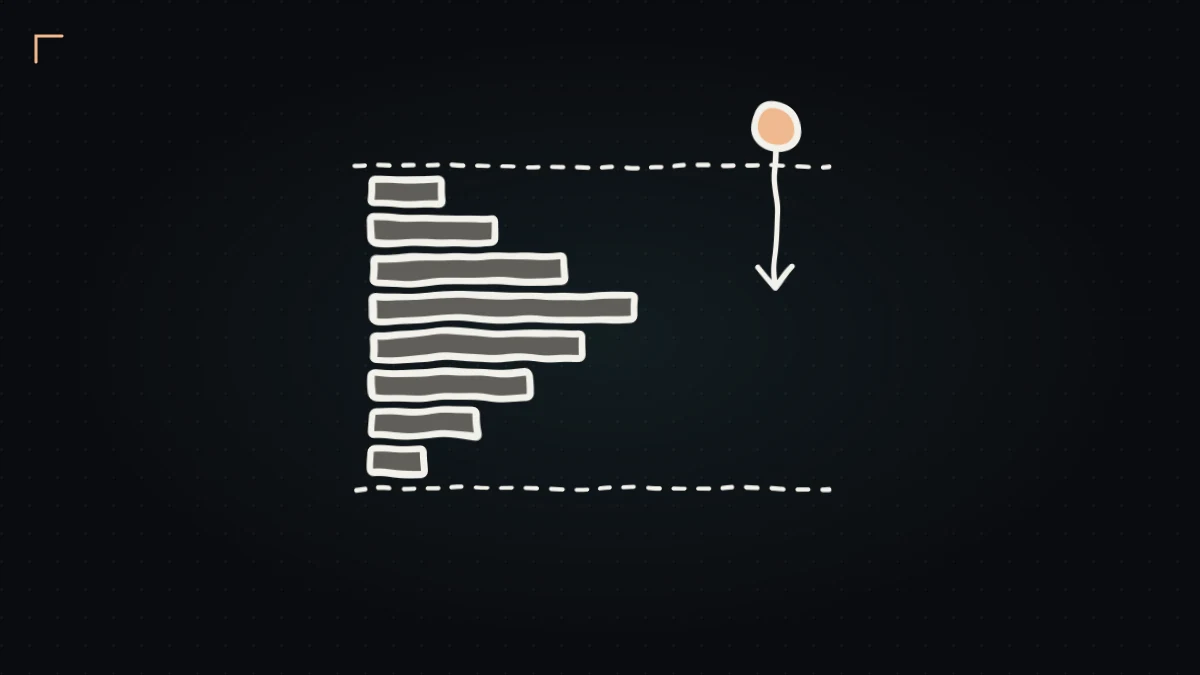
The first 30 minutes of the trading session contain more predictive information than most traders realize. Specifically, where the market opens relative to the prior session's high and low tells you which type of day is statistically most likely — and that changes everything about how you trade.
This concept is called Open Type classification, and it's one of the most powerful tools in market profile analysis.
What Is Open Type?
Open Type classifies the current session's opening price relative to the prior day's range — the span between the prior high (pH) and prior low (pL). It answers a simple question:
"Where did the market open compared to where it traded yesterday?"
The secondary reference point is the prior day's close (pCl), which divides the range into an upper and lower half. Together, these two references — the range boundaries and the close — produce five distinct open type classifications, each with measurably different statistical implications for how the rest of the day unfolds.
The 5 Open Type Classifications
HOR — Higher Out of Range
Definition: The market opens above the prior day's high (above pH). The market has gapped entirely above yesterday's range.
What it means: Overnight buyers drove price beyond the prior session's highest point. This is the most aggressively bullish opening condition — the market is in new territory relative to yesterday.
ES statistics (305 days):
| Level | Test Rate |
|---|---|
| Prior High (pH) | 68.9% |
| Prior Low (pL) | 14.4% |
| Prior Close (pCl) | 50.2% |
| Prior Value Area High (pVH) | 53.8% |
| Prior Value Area Low (pVL) | 22.3% |
The prior high gets tested in nearly 7 out of 10 HOR sessions — even though the market opened above it. The prior low, by contrast, is reached less than 1 in 7 times, reflecting the strongly directional character of these opens.
How to trade: Look for continuation in the direction of the gap. If the market pulls back toward the prior high and holds, that's a high-probability long entry. If it closes back below the prior high with acceptance, the gap thesis is failing — step aside.
HIR — Higher In Range
Definition: The market opens inside the prior day's range (between pL and pH) but above the prior day's close (above pCl).
What it means: The market opened within yesterday's range in the upper half — above where it settled. There is a moderate bullish bias, but the market is still operating within known territory.
ES statistics (427 days — most frequent open type):
| Level | Test Rate |
|---|---|
| Prior High (pH) | 59.7% |
| Prior Low (pL) | 32.3% |
| Prior Close (pCl) | 70.3% |
| Prior Value Area High (pVH) | 72.6% |
| Prior Value Area Low (pVL) | 52.0% |
HIR is the most common open type in ES (~32% of sessions). The prior close is tested in 70% of HIR days, and the prior value area high in nearly 73%. This reflects the rotational character of in-range opens — the market tends to explore both directions rather than trend cleanly.
How to trade: The prior close acts as a key pivot. Rotations between the upper reference levels (pVH, pH) and the prior close are common. Watch for whether the market can sustain above pCl — if it can't, a test of the value area low or prior low becomes more likely.
NOR — Neutral Open Range
Definition: The market opens at (or within a tick of) the prior day's close (pCl).
What it means: The market opened exactly where it left off. This is a true equilibrium opening — neither buyers nor sellers gained overnight control. NOR is by far the rarest open type.
ES statistics (13 days — very rare):
| Level | Test Rate |
|---|---|
| Prior High (pH) | 38.5% |
| Prior Low (pL) | 30.8% |
| Prior Close (pCl) | 92.3% |
| Prior Value Area High (pVH) | 38.5% |
| Prior Value Area Low (pVL) | 38.5% |
The 92.3% test rate for the prior close is almost trivially explained — the market opens there. What's notable is that pH and pL are tested in roughly equal rates (~38% vs ~31%), confirming the balanced, two-way character of these sessions. Both IB boundaries are tested in 100% of NOR sessions in this dataset.
How to trade: Expect a two-sided, rotational session. Neither bulls nor bears have the initiative. Trade the extremes and use the prior close as a central pivot. Avoid pressing for large directional moves.
LIR — Lower In Range
Definition: The market opens inside the prior day's range (between pL and pH) but below the prior day's close (below pCl).
What it means: Mirror image of HIR. The market is within yesterday's range but in the lower half — below where it settled. Moderate bearish bias.
ES statistics (386 days):
| Level | Test Rate |
|---|---|
| Prior High (pH) | 43.5% |
| Prior Low (pL) | 51.3% |
| Prior Close (pCl) | 75.9% |
| Prior Value Area High (pVH) | 59.6% |
| Prior Value Area Low (pVL) | 67.9% |
LIR shows the inverse of HIR — the prior low is tested more than half the time, and the prior value area low in nearly 68% of sessions. Like HIR, the prior close has a high test rate (76%), again reflecting the rotational nature of in-range opens.
How to trade: Similar logic to HIR but inverted. The prior close is the key pivot. If the market can't reclaim it, rotations toward the prior low and value area low become likely. Sustained acceptance below the value area low would shift the thesis toward a potential trend day lower.
LOR — Lower Out of Range
Definition: The market opens below the prior day's low (below pL). The market has gapped entirely below yesterday's range.
What it means: Mirror image of HOR. Overnight sellers pushed price below the prior session's lowest point. The most aggressively bearish opening condition.
ES statistics (206 days):
| Level | Test Rate |
|---|---|
| Prior High (pH) | 11.7% |
| Prior Low (pL) | 67.0% |
| Prior Close (pCl) | 40.3% |
| Prior Value Area High (pVH) | 18.4% |
| Prior Value Area Low (pVL) | 45.1% |
The prior low is tested in 67% of LOR sessions — nearly identical to HOR's pH test rate (68.9%). The prior high is almost never reached (11.7%), which mirrors HOR's pL test rate (14.4%). The symmetry between HOR and LOR is striking.
How to trade: Look for continuation shorts. If the market rallies back to the prior low and stalls, that's a high-probability short entry. If it reclaims and accepts above the prior low, the LOR thesis is failing.
Open Type Distribution in ES
Based on real ES data (~1,337 sessions):
| Open Type | Sessions | Frequency |
|---|---|---|
| HIR | 427 | ~32% |
| LIR | 386 | ~29% |
| HOR | 305 | ~23% |
| LOR | 206 | ~15% |
| NOR | 13 | ~1% |
In-range opens (HIR + LIR) account for roughly 60% of all sessions. Out-of-range opens (HOR + LOR) account for nearly 38%. NOR is rare enough to be treated as a special case when it appears.
Why the Range — Not the Value Area?
The key distinction that's often misunderstood: Open Type uses the prior day's price range (the literal high-to-low span) as its reference, not the value area (the central 70% of volume distribution).
The value area is a useful context tool, but the range boundaries are the structural reference for Open Type classification. The range boundaries represent where price actually traded at its extremes — that is what defines whether the market opened inside or outside of yesterday's activity.
The prior close within that range acts as the secondary divider: it tells you whether the upper or lower half of the range has the bullish or bearish bias on in-range opens.
How to Identify Open Type in Real-Time
Open type classification is determined within the first few minutes of RTH (Regular Trading Hours). Here's the process:
- Before the open: Note yesterday's high (pH), low (pL), and close (pCl)
- At the open: Observe the first print (or first 1-5 minute bar)
- Classify:
- Above pH → HOR
- Between pCl and pH → HIR
- At pCl → NOR
- Between pL and pCl → LIR
- Below pL → LOR
- Adjust your plan: Select strategies and reference levels appropriate for that open type
This can be done manually, but tools like StatLevels Suite automate this classification in real time, displaying context-aware statistics directly on your chart so you know the relevant probabilities from the moment the market opens.
Level Probabilities by Open Type
The same level has different probabilities depending on the open type. This is the central insight:
| Level | HOR | HIR | NOR | LIR | LOR |
|---|---|---|---|---|---|
| Prior High (pH) | 68.9% | 59.7% | 38.5% | 43.5% | 11.7% |
| Prior Low (pL) | 14.4% | 32.3% | 30.8% | 51.3% | 67.0% |
| Prior Close (pCl) | 50.2% | 70.3% | 92.3% | 75.9% | 40.3% |
| Prior VA High (pVH) | 53.8% | 72.6% | 38.5% | 59.6% | 18.4% |
| Prior VA Low (pVL) | 22.3% | 52.0% | 38.5% | 67.9% | 45.1% |
Based on ES data. Percentages represent sessions where each level was tested at least once.
A trader who assigns the same probability to the prior high regardless of open type is ignoring the most important context variable available. In HOR, pH is tested nearly 69% of the time. In LOR, it's 12%.
Trading Plans by Open Type
HOR / LOR — Gap Opens
Primary bias: Trade with the gap direction.
- A pullback to the gap boundary (pH for HOR, pL for LOR) that holds is a high-probability entry in the gap direction
- If the gap boundary is reclaimed with acceptance, the day type may be shifting — reassess
What to watch: The prior close tells you how deep the gap is and how likely a full gap fill becomes. In HOR, the pCl is tested about 50% of the time — so a full gap fill is far from guaranteed, but it's also not rare.
HIR / LIR — In-Range Opens
Primary bias: Two-sided, with a lean toward the close.
- The prior close is the key pivot — both HIR and LIR test it roughly 70-76% of the time
- On HIR days, the upper value area and prior high are also frequently tested
- On LIR days, the lower value area and prior low are frequently tested
This is where most rotational trading opportunities live. The prior close, value area boundaries, and range extremes all have defined, measurable probabilities you can use to build structured trade ideas.
NOR — Equilibrium Open
Primary bias: Balanced and two-sided.
- Expect exploration of both sides without a clear directional lean
- Prior high and low are tested at roughly equal rates
- Position sizing should reflect the lack of directional edge
Combining Open Type with Position Sizing
Open type should influence not just your strategy but your position sizing:
| Open Type | Context | Suggested Risk Level |
|---|---|---|
| HIR / LIR (in-range, rotational) | High — statistical edge in both directions | Full risk |
| HOR / LOR (gap confirmation) | Medium — trend potential, needs confirmation | Standard risk (75%) |
| NOR (equilibrium) | Lower — no directional bias | Reduced risk (50%) |
| Counter-trend in HOR / LOR | Low — fighting a gap | Minimal risk (25%) |
This is where risk presets become practical. Instead of using the same size on every trade, you scale risk to the statistical quality of the setup — which is directly informed by the open type.
Key Takeaways
- Open type is defined by the prior day's range (pH and pL), not the value area — this is the most important distinction
- Five categories: HOR, HIR, NOR, LIR, LOR — with HOR/LOR for out-of-range opens and HIR/LIR for in-range opens split by the prior close
- Same levels, different probabilities — every reference level's test rate is conditional on open type
- HIR and LIR are the most common (~60% of sessions in ES) and produce rotational, two-sided trading days
- HOR and LOR signal potential trend days — trade with the gap, not against it
- NOR is very rare — less than 1% of sessions in ES — and signals a balanced, low-directional day
- Scale position size to the confidence level each open type's context provides
Noesis Analytics
Put the numbers on your chart.
Level statistics and automatic position sizing for Sierra Chart — with a 7-day free trial.