·Market Profile·Statistical Trading·Day Trading
Prior Day High and Low: Do These Levels Actually Matter? A Statistical Analysis
Every trader marks the prior day's high and low on their chart. But do these levels have a real statistical edge? We analyze the data and show when they work best.
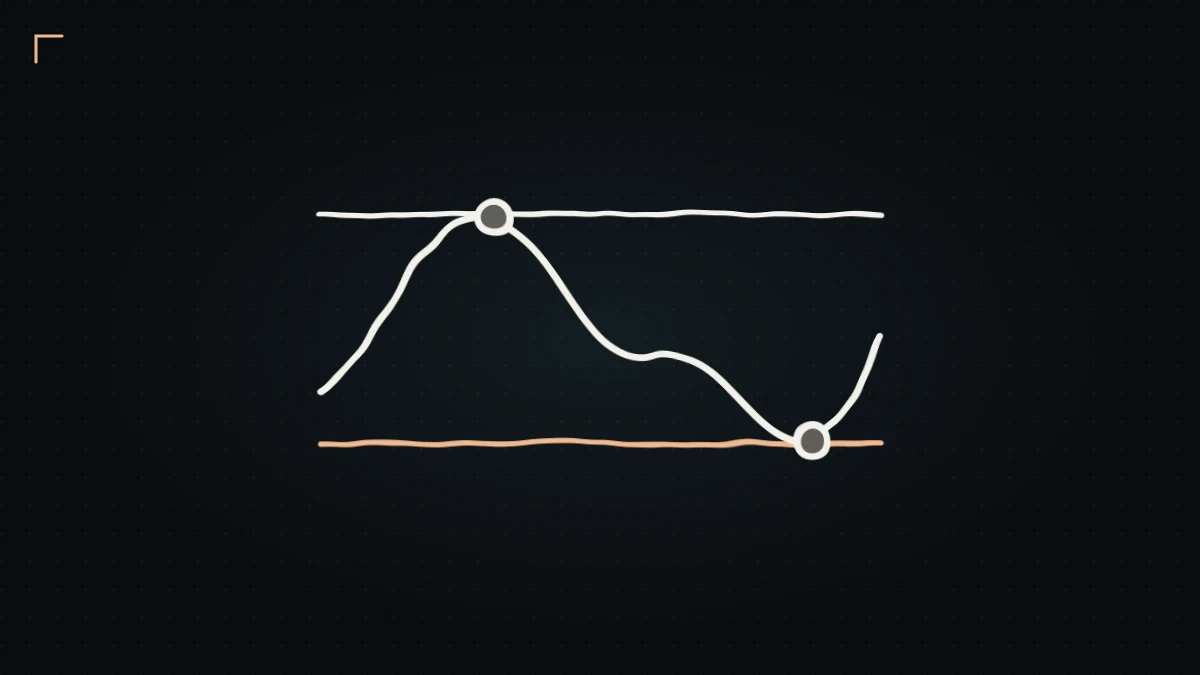
Open any trading education course and one of the first things you'll learn is: "Mark the prior day's high and low on your chart." It's universal advice. Every trader does it.
But here's the question nobody asks: do these levels actually work? And more importantly, when do they work and when don't they?
The answer, like most things in trading, is: it depends on context. Let's look at what the data actually shows.
The Baseline Statistics (ES, ~1,337 Sessions)
Based on real ES data, here are the actual test rates for the prior day's high and low across all sessions:
- Prior Day High (pH) tested: ~49.5% of sessions
- Prior Day Low (pL) tested: ~39% of sessions
- Both tested in the same session: ~11%
- Neither tested: ~23%
Already this differs from the "50-70%" rule of thumb often cited. But even these overall numbers are misleading — they blend together five very different market conditions. The real picture emerges when you break them down by open type (how the current session opened relative to the prior day's range and close):
| Open Type | Sessions | pH Tested | pL Tested |
|---|---|---|---|
| HOR (open above pH) | 305 | 68.9% | 14.4% |
| HIR (in range, above pCl) | 427 | 59.7% | 32.3% |
| LIR (in range, below pCl) | 386 | 43.5% | 51.3% |
| LOR (open below pL) | 206 | 11.7% | 67.0% |
| NOR (open at pCl) | 13 | 38.5% | 30.8% |
The range is enormous. On HOR days (gap up above the prior high), the prior high is tested almost 69% of the time — while the prior low is almost never reached (14.4%). On LOR days, this inverts exactly. The symmetry is striking and statistically meaningful.
By themselves, the overall averages aren't actionable. A 49.5% pH test rate doesn't tell you whether to buy, sell, or wait. But 69% on HOR vs 12% on LOR — that's a real edge.
The real value comes when you use open type as the primary filter.
Context Changes Everything
Open Type as the Primary Filter
Open Type classifies the session's opening price relative to the prior day's high (pH), low (pL), and close (pCl). The five types and their effect on pH/pL test rates are clear from the real ES data above.
HIR and LIR (open inside range): The market opened between pH and pL. Both levels are nearby, test rates for both are elevated. Rotational days often touch both extremes — but even here, the directional lean matters: HIR days test pH more often (59.7%) than pL (32.3%), while LIR days flip this (43.5% pH vs 51.3% pL).
HOR (open above pH): The market already exceeded the prior high before RTH. pH is a natural pull-back target — 68.9% of HOR days still test it. pL is rarely reached (14.4%) unless the gap completely reverses.
LOR (open below pL): Mirror image of HOR. pL gets tested in 67% of sessions (as a bounce target), pH almost never (11.7%).
NOR (open at pCl): Rare equilibrium open. Both levels are tested at similar, moderate rates (~38% for pH, ~31% for pL) reflecting the balanced character of these sessions.
This is the fundamental insight: the prior day high and low don't have fixed probabilities. Their significance is entirely conditional on the opening context.
How to Trade the Prior Day High
Scenario 1: Price Approaching from Below (Potential Resistance)
The prior day high often acts as resistance when approached from below. This makes intuitive sense — sellers who bought near yesterday's high may be looking to exit at breakeven, creating supply.
Fade setup:
- Price rallies to prior day high during an inside-value open (HIR/NOR)
- Look for rejection: decreasing buying volume, lower highs on smaller timeframes
- Enter short targeting VPOC or mid-range
- Stop: above prior day high + buffer
When to avoid the fade: If the market opened with a HOR (gap up above value), the prior day high has already been exceeded by the gap. Don't short at a level that's already been broken.
Scenario 2: Breakout Above Prior Day High
When price breaks and holds above the prior day high, it signals that sellers at yesterday's extreme have been absorbed and new buyers are stepping in.
Breakout setup:
- Price breaks above prior day high with above-average volume
- Pullback to prior day high (now support)
- Enter long on the retest
- Target: measured move or IB extension levels
- Stop: below the breakout candle
How to Trade the Prior Day Low
Scenario 1: Price Approaching from Above (Potential Support)
Mirror image of the prior day high resistance scenario. Buyers who sold near yesterday's low may be looking to cover, creating demand.
Fade setup:
- Price drops to prior day low during an inside-value open (LIR/NOR)
- Look for rejection: decreasing selling volume, higher lows
- Enter long targeting VPOC or mid-range
- Stop: below prior day low + buffer
Scenario 2: Breakdown Below Prior Day Low
When price breaks and holds below the prior day low, sellers are in control and the market is exploring lower value.
Breakdown setup:
- Price breaks below prior day low with volume
- Pullback to prior day low (now resistance)
- Enter short on the retest
- Target: measured move lower
- Stop: above the breakdown candle
The Prior Day Range in Context
Beyond the individual high and low, the prior day's total range provides context:
Wide Prior Day Range
- High and low are far apart
- Both levels are less likely to be tested in a single session
- Focus on whichever level is closer to the current price
Narrow Prior Day Range
- High and low are close together
- Both levels may be tested multiple times
- The narrow range often precedes a breakout — when both levels break, one direction tends to win decisively
Inside Day Pattern
When today's entire range fits within yesterday's range (today's high < yesterday's high AND today's low > yesterday's low), this is an "inside day." Inside days are compression patterns that often resolve with a directional breakout on the following session.
Combining Prior Day Levels with Other References
The prior day high and low become most powerful when they align with other market profile levels:
| Confluence | Significance |
|---|---|
| Prior Day High = VAH | Double resistance — rejection is more likely |
| Prior Day Low = VAL | Double support — bounce is more likely |
| Prior Day High = Overnight High | Multi-session resistance — very significant |
| Prior Day Low near VPOC | Strong support zone with volume backing |
| Prior Day High = IB High | First-hour range confirmed by prior day — key level |
The more references that cluster at a single price, the more significant that level becomes. A prior day high by itself is a single data point. A prior day high that aligns with the value area boundary and the overnight high is a confluence zone backed by multiple statistical references.
This is why tools that track multiple levels simultaneously with probability data are more effective than manually marking two lines on your chart. When you can see 15 reference levels with context-aware statistics at a glance, you identify confluence zones that would take much longer to spot manually.
Overnight High and Low: The Forgotten Levels
While we're discussing prior day levels, let's address two levels that deserve more attention: the overnight high and overnight low.
Overnight session = Globex trading outside RTH (roughly 6 PM - 9:30 AM ET for US futures)
The overnight high and low represent the extremes established by global participants before the US session opens. Their significance:
- If RTH opens between overnight high and low, both are nearby references
- If RTH opens above overnight high, that level becomes support (already broken upward)
- If RTH opens below overnight low, that level becomes resistance (already broken downward)
The overnight range often provides tighter, more immediately relevant levels than the prior day range — especially when the overnight session was volatile.
The Statistical Edge
So, do prior day high and low "work"? Yes, but only when used correctly:
They work when:
- Combined with open type context (knowing the probability under current conditions)
- Used as part of a multi-level framework (not in isolation)
- Traded with proper risk management (fixed risk, not fixed contracts)
- Applied with awareness of the prior day's range width
They don't work when:
- Treated as absolute support/resistance without context
- Used identically regardless of open type
- Traded without stops or with excessive size
- Blindly faded on trend days
The difference between a trader who makes money from these levels and one who doesn't isn't the levels themselves — it's the statistical context they apply to each trade decision.
Key Takeaways
- Overall: pH tested ~50%, pL tested ~39% — but broken down by open type the range is 12–69%, which is where the real edge lives
- Open type is the primary filter — HOR/LOR gap opens create a 4–6x difference in test probability for the far level
- Confluence with other levels (VAH, VAL, overnight range) increases significance
- Wide prior day ranges make both levels less likely to be tested in one session
- Narrow prior day ranges often precede breakout moves
- Don't trade these levels in isolation — combine with volume, open type, and other market profile references
- Measure the actual probabilities for your specific contract and conditions rather than relying on generic rules
Noesis Analytics
Put the numbers on your chart.
Level statistics and automatic position sizing for Sierra Chart — with a 7-day free trial.